

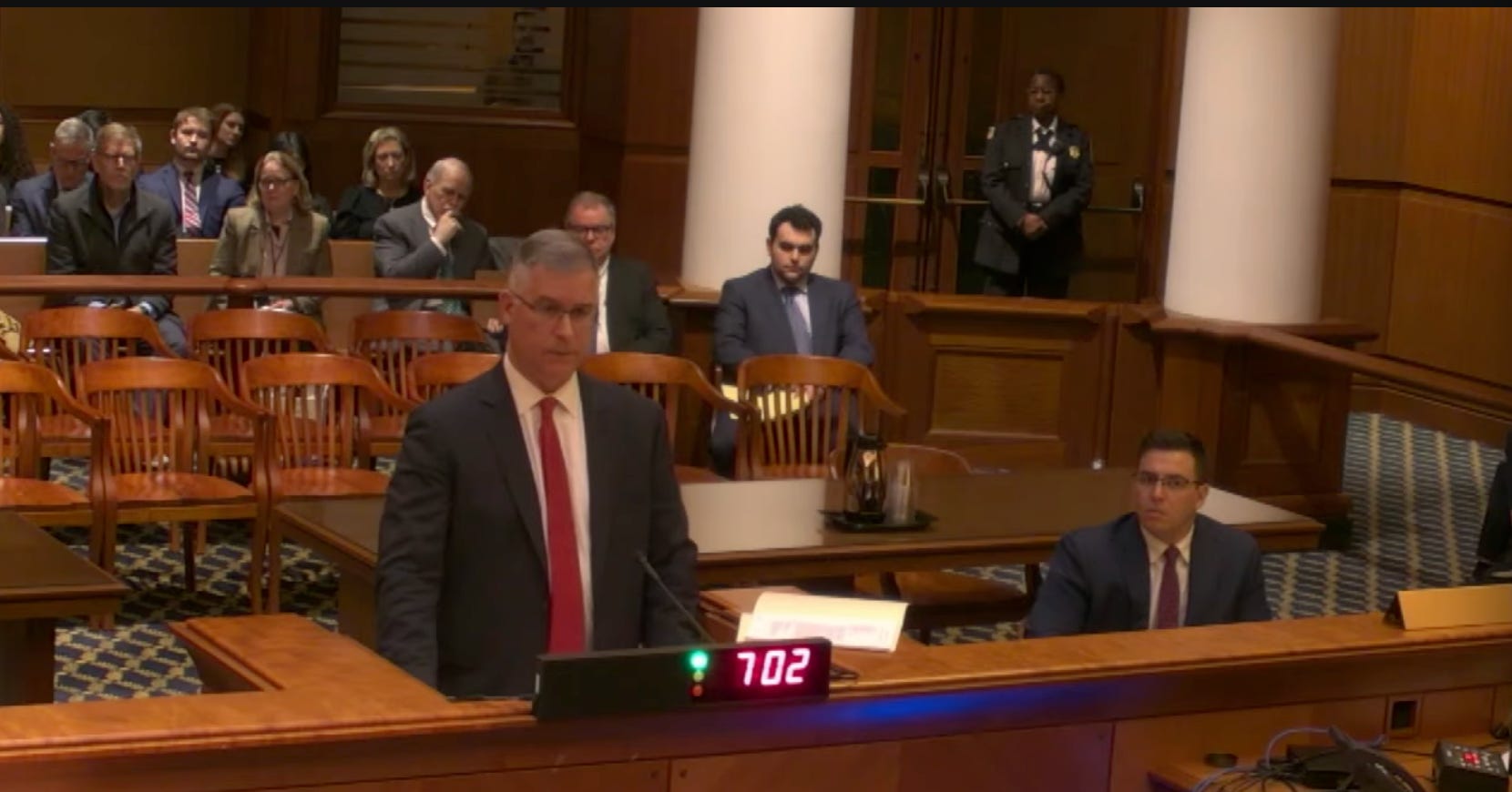
March 4, 2026 (Boston) — Four minutes into his arguments before the Supreme Judicial Court this morning, Marshfield Town Counsel Robert Galvin had to admit that he did not have a case against the MBTA Communities Act.
“The attorney general has said that this could have been complied with by one sentence,” said Justice Dalila Argaez Wendlandt, “Why is that not? What’s your response to that?”
Galvin listed some of the requirements of the law, then asserted that the law “didn’t require the town to adopt a blanket adoption of multifamily housing.”
“Couldn’t the Town of Marshfield have complied by simply allowing multifamily housing in all of its districts?” replied Wendlandt.
“I think that it could have done that, Your Honor,” said Galvin.
“It could have done that, yes,” said Wendlandt. “It could have been done.
“So what's the expense of that one sentence in allowing all districts in Marshfield to have multifamily housing?” she asked.
With that, the Town of Marshfield’s case against the MBTA Communities Act was over.
In his February 2025 complaint file on behalf of the town, Galvin argued that the MBTA Communities Law was an unfunded mandate. He also argued that the statute was incorrectly constructed because it compelled voters “to vote to approve a zoning district.”
Much of Galvin’s written appeals were about this voting rights issue, but he was not allowed to present that argument to the court because it was not the basis upon which his appeal was grant.
The justices said that arguments should be narrowly laid out around the grounds for the dismissal, which related to the burden imposed by the unfunded mandate.
The problem was that Galvin was unable to detail those expenses, nor could he show that they were necessary.
“The framework that we're here on a motion to dismiss, is the statute itself requires direct compulsory non-incidental obligations, right?” said Justice Serges Georges, Jr., “so if you just have in your complaint these generalized allegations of additional administrative burdens or the cost that went into kind of local lawmaking, in that paragraph that was just read, talks about some speculative maybe downstream costs.”
Galvin did not detail costs in his original complaint, nor did he amend the complaint to include them, as is normal procedure. Instead, he tried to tie Marshfield costs of compliance to the costs detailed in complaints for other town.
“The law from the decisions in the Methuen case and in the Middleborough case and the Wenham case is what I incorporated by reference,” he said.
“You could have amended your complaint, but you didn’t,” said Justice Wolohojian.
Galvin said that he had not.
“I mean, this is the basic problem,” Justice Wolohojian replied. “You’re facing a motion to dismiss. The normal solution is not to try to get in things that are outside pleading, but to look at a motion to dismiss in reference to the face of the pleading, or to seek to amend the pleading to specify exactly what you’re relying on in terms of factual allegations. I don’t know about this process that you’re proposing, which is to look at anything that’s said in a brief or something that’s attached to a brief. Rule of civil procedure covers that.”
Nor could he prove that they were necessary.
Justice Georges even admonished him for making basic errors.
“You’ve tried a lot of cases,” he said, “and you know that the standard jury instruction for reasonable inferences is they’re based on facts that have been proved to you.”
The core issue appeared to be that the unfunded mandate only applies to necessary expenses. The justices appear to agree with the attorney general’s office’s argument that the consultants fees incurred were not necessary, but rather something voters wanted so they could get better zoning.
“This is complex politically,” said Justice Scott Kafker, “but not, this isn't like an environmental regulation where you need to hire a consultant to analyze. Exactly, this is just politically complicated.”
“Exactly, and those costs again are not imposed by the statute,” replied Esme Caramello, Director of the AG’s Housing Affordability Unit, arguing for the Commonwealth.
“They may be there,” she said, “they may be real, but they’re imposed by the community itself, not in a negative way, but that’s where they come from.”
The justices did not consider Galvin’s arguments about voter rights because it was not part of the basis of appeal.
Caramello briefly addressed those arguments at the end of the session.
If the court would like to hear argument on the second, on the town meeting voting rights argument, we believe that to the extent that's a constitutional claim, the town does not have standing to bring it. To the extent that it's a claim under Section 40A or general laws 40A Section 5, we just have two statutes that don't conflict with each other and it should be read harmoniously to give full effect to each of them.
She is arguing that the town does not have standing because town is the creation of the state and doesn’t have any rights constitutionally reserved for it in the way the U.S. Constitution reserves rights for the state.
The SJC has consistently upheld this principle.
The MBTA Communities Law requires towns to establish zoning districts close to public transit where multifamily housing is allowed by right.
In June 2025, a lower court dismissed a series of cases against the law, including one filed by the Town of Marshfield.
Marshfield has since passed MBTA Communities zoning using the paper compliance strategy of placing the zones in areas that it are unlikely to be redeveloped. The plan was to repeal the zoning if the appeal was successful.
Oral Argument Transcript, Town of Marshfield v. Commonwealth, SJC-13840
Clerk: SJC 13840, Town of Marshfield v. Commonwealth, Massachusetts et al. Attorney Galvin.
Robert Galvin: Good morning, Your Honors. May it please the Court. Attorney Robert Galvin representing the Town of Marshfield. Your Honours, this is a case the effect of which was to compel the town of Marshfield’s legislative body, the town meeting, to adopt a multifamily housing district where there are no discretionary approvals permitted. This is an area that has traditionally been reserved zoning for municipalities. The impact of the MBTA community’s law was to cause the town to bear some extraordinary expense, comply with 22 pages of regulations, formally guidelines, previously stricken by the court, and to bear the ultimate expense.
Justice Dalila Argaez Wendlandt: What were the expenses?
Galvin: The expenses for the town of Marshall?
Justice Wendlandt: Yeah, and how were they necessary?
Galvin: Your Honor, there were 22 pages of guidelines promulgated.
Justice Wendlandt: Yeah, but what were the Marshfield expenses? I know the guidelines exist.
Galvin: Marshall was forced to employ a person to develop modeling. We had no experience applying the compliance regulations. We had to incur expense associated with that, a series of interactions with the housing and livable communities where we developed various types of models, had to exclude areas of the town where this was even permitted because we had to develop a district of reasonable size, location, and density, had to test those models, frequently come back and forth, and then ultimately we developed a district that the planning board approved and was presented to town meeting.
Justice Wendlandt: And why were those, why did you have to develop modeling?
Galvin: Because the regulations required us.
Justice Wendlandt: Modeling? Correct. Where do the regs require modeling?
Galvin: Sorry, Your Honor, I didn’t have that off the top of my head.
Justice Wendlandt: Well, you’re saying it’s an unfunded mandate, and I’m wondering what the funds are that the town of Marshfield claims was required to expend in order to comply with the statute that just requires one district of reasonable size in which multifamily housing is permitted as of right. It’s more specifically, the attorney general has said that this could have been complied with by one sentence. Why is that not? What’s your response to that?
Galvin: Well, Your Honor, I disagree that that’s what the law required. The law actually required the development of a district of reasonable size. And that district had to meet certain requirements, both guidelines and then regulations. It didn’t require the town to adopt a blanket adoption of multifamily housing.
Justice Wendlandt: But couldn’t the town of Marshfield have complied simply allowing multifamily housing in all of its districts?
Galvin: I think that it could have done that, Your Honor.
Justice Wendlandt: It could have done that, yes. It could have done that. So what’s the expense of that one sentence in allowing all districts in Marshfield to have multifamily housing?
Galvin: I would think that that expense would be fairly nominal if we adopted simply what the Attorney General was suggesting, Your Honor.
Justice Wendlandt: Why would that not, why wouldn’t that, doesn’t that vitiate your case that this is an unfunded mandate? Can you just sort of explain how the case goes on?
Galvin: In my view, the statute required not that the town allow multifamily anywhere.
Justice Wendlandt: Well, I know that that’s not what the statute requires. It’s how you could have complied. Could have complied with the statute.
Galvin: Well, Your Honor, I certainly disagree with you, Your Honor. The statute mandated the town develop a zoning district a reasonable size with certain density, and that was the mandate that we received, and that was the mandate that we required. If the state had merely incorporated this into Section 3 and made it a subject that we couldn’t regulate, or regulate subject to say no discretionary approval is subject to reasonable regulations, they could have done that and made it very simple for the town of Marshfield, but they didn’t, Your Honor.
Justice Wendlandt: No, I, I guess I, I mean maybe it’s just convenient for you to change the question, but the question is not whether the statute mandated that the town of Marshfield housing in all of its districts. My question was really why couldn’t you have complied with the statute that requires one district of reasonable size by allowing multifamily housing in every district?
Galvin: I think I tried to answer that directly, Your Honor, and I think that the answer is the town could have done that.
Justice Scott L. Kafker: Our cases say that forcing you to make difficult choices is not a mandate, right?
Galvin: I agree, Your Honor, but those...
Justice Kafker: That’s where I lose you. I understand modeling may have been expensive, but you made a choice to sort of try to accomplish the statute that way as opposed to another, and that seems to fall within our case law, but it’s not a mandate.
Galvin: I disagree, Your Honor. I do think that the statute did not direct us to just allow multifamily housing in any district. It directed us to develop a district of reasonable size with density, location requirements, and a whole series of guidelines that I’ve never seen required in connection with the adoption of any zoning bylaw before. This is very unique. And that’s what caused the expense to the town of Marshfield. Now, was that an expense that...
Justice Kafker: It just seems like it fits within classic incidental expense. The fact that it was more expensive was a choice you made.
Galvin: Your Honor, I disagree, Your Honor. In order to comply with these guidelines and their regulations, which is what the mandate was, certainly there was expense involved, and I disagree that this falls within the case law that says that this was a tough choice that we had to make. I don’t think that that was in any way, shape, or form. What the planner did in Marshfield, Your Honor, is to try to find an area where we could actually accommodate this use. It’s been argued by the Attorney General in this case that we were doing something bespoke or something of that nature. Your Honor, Marshfield is a rural town, relatively speaking. We’re not the smallest town, but we’re not the largest town either. And there’s a whole series of places in the town of Marshfield where it would not even be physically possible to locate a development like this. Multifamily development just wouldn’t work. The roads are not sufficient to handle this. What the planner did is spent extraordinary time and expense trying to model a place where a location like this would work, and it would be the least expense to the town of Marshfield.
Justice Kafker: Was it a planner on staff?
Galvin: We have a planner on staff, and we hired an additional planner, Your Honor.
Justice Kafker: Isn’t that, again, like the follow-up to the bus case that we decided, the old case that described...
Galvin: The Lexington case, Your Honor, I believe, Lexington 2, by busing for private school students where the town had already agreed to provide busing. I thought that was an effort, more of an effort to clarify existing law, Your Honor, and the town had voluntarily chosen to do this already. This in no way, shape, or form was something that the town of Marshfield chose in any way. This was something that we were required to do.
Justice Serge Georges, Jr.: So we’re here on an appeal from a decision on a motion to dismiss, correct? So to my mind, at least, that means that we’re really looking at the allegations of the complaint. So to follow up on the question of the expenses or costs incurred by Marshfield, can you point me to the specific paragraphs of your complaint that contain any of these explanations of costs and expenses you’ve just outlined here during oral argument?
Galvin: Your Honor, I did concede that we didn’t detail every cost and expense.
Justice Georges: I’m just looking for any. What are the paragraphs of your complaint?
Speaker 6: Paragraph 52, Your Honor.
Justice Georges: Let’s look at that.
Galvin: We also incorporated, by reference, the Division of Local Decisions.
Justice Georges: 52 says the Marshfield parties expect to incur additional costs as a direct result of the mandatory requirements.
Galvin: I believe if you look at the prior paragraph, Your Honor.
Justice Gabrielle R. Wolohojian: One says they have incurred costs and expenses in evaluating and drafting proposed zoning laws. Yes, Your Honor. That’s what you’re relying on?
Galvin: Well, that and the prior incorporation of the divisional local mandate determinations by the Office of the Inspector General.
Justice Wolohojian: What do we do with the judge’s conclusion that these don’t meet a sufficient pleading standard?
Galvin: Well, Your Honor, I disagree with that. I know, but the allegations are true and the reasonable inferences that we made. Remember, the record also included Mr. Guimond’s affidavit because the motions to dismiss and motions from preliminary injunction were held at the same time. And we explained how there were technical expenses and hundreds of hours that were developed in creating this bylaw and the tasks that were involved.
Justice Serges Georges, Jr.: Can I follow up with Justice Waller-Hogins’ question. But the problem, I guess, in the framework that we’re here on a motion to dismiss, is the statute itself requires direct compulsory non-incidental obligations, right? So if you just have in your complaint these generalized allegations of additional administrative burdens or the cost that went into kind of local lawmaking, in that paragraph that was just read, talks about some speculative maybe downstream costs. How does that fit within the Rule 12 standard? Because that’s the part that I think we’re going to have to grapple with, is where’s the specificity that you’re claiming is tied to the extra that the statute requires?
Galvin: Your Honor, we argued to the Superior Court at the time of the motion to dismiss that the pleadings were sufficient because we alleged direct service cost obligations, and we supplemented that with our briefing where we explained, and I attached Mr. Giemann’s affidavit that explained that these were technical. Outside. So the briefing, in my view, explained why the reasonable inferences should have been granted in favor of the town.
Justice Georges: But reasonable inferences are based on facts. Right. So are there facts that say line item by line item that we can point to and say these are the direct consequential costs of having to comply that are outside of the local stuff that we have to do in any event?
Galvin: We did not detail those.
Justice Georges: That’s what I’m getting at. So you’re asking us to rely on reasonable inferences, but no. You’ve tried a lot of cases, and you know that the standard jury instruction for reasonable inferences is they’re based on facts that have been proved to you. Yes. So we need those facts, don’t we? Don’t we need the index facts?
Galvin: Yes, Your Honor. And what I have suggested to you is that we incorporated the claims, the findings from the Division of Local Mandates, which said that these were more than incidental expenses, incorporated them by reference to the complaint, and then we argued that the reasonable inferences were that these were more than incidental expenses, and we supplemented that with the affidavit by Mr. Gaiman.
Justice Wolohojian: But the opinion that you’re relying on doesn’t relate to the town of Marshfield.
Galvin: There was a case, Your Honor, that I cited in my brief.
Justice Wolohojian: I’m talking about the analysis by the state auditor’s division. Is that the opinion that you’re saying was incorporated by reference?
Galvin: It’s the law from that case, Your Honor. The law from the decisions in the Methuen case and in the Middleborough case and the Wenham case is what I incorporated by reference. And in those three determinations, which Marshfield subsequently obtained one, but it was after the record was closed and after the decision was made, but it had the same or similar language, all said that these were more than incidental expenses that were incorporated. So that is an inference that we asked the Superior Court Judge to draw in our favor. And the crux of our unfunded mandate claim at this particular stage is that we never get an opportunity to try to explain these expenses. And because we were deprived of that ability to explain those expenses, we were not able to, the Superior Court judge was wrong in drawing.
Justice Wolohojian: You could have amended your complaint, but you didn’t.
Galvin: You did not amend our complaint. Right.
Justice Wolohojian: I mean, this is the basic problem. You’re facing a motion to dismiss. The normal solution is not to try to get in things that are outside pleading, but to look at a motion to dismiss in reference to the face of the pleading, or to seek to amend the pleading to specify exactly what you’re relying on in terms of factual allegations. I don’t know about this process that you’re proposing, which is to look at anything that’s said in a brief or something that’s attached to a brief. Rule of civil procedure covers that.
Galvin: Well, Your Honor, there is a rule that allows you to look when you’re dealing with a motion to dismiss other information in the record and beyond the four corners of the complaint.
Justice Wolohojian: It’s a very limited rule.
Galvin: I agree, Your Honor. But in the complaint, we referenced the opinions that were issued by the Division of Local Mandates in which these findings were made. And I think that’s more than sufficient at this stage where all of the inferences have to be drawn in our favor and not in favor of the Commonwealth to get past this burden.
Justice Kafker: I’m just trying to figure out, how do we take the fact, okay, there are other towns, Middleborough, you say, and two other towns. How do we know that their expenses are the same as yours? How do we make that jump? I’m not sure I follow that.
Galvin: I’m not sure. I think every circumstance in every town has to be looked at differently.
Justice Kafker: But then don’t you lose?
Galvin: No, Your Honor. If there’s nothing in yours that defines what you did, and you’re relying on the division of whatever it is, which is interpreting three different towns, I just don’t see how you can bootstrap that.
Galvin: Well, Your Honor, again, we were incorporating the fact that there had been a determination by another state agency.
Justice Kafker: But about different towns and different expenses.
Galvin: Right, but that’s what actually opened the door for us to file the petition. Once there had been a determination in any community that the law was an unfunded mandate, and that’s what the determination was by the Division of Local Mandates, Marshfield then decided to bring the unfunded mandate claim.
Justice Kafker: I get that triggered, but you have to allege your own specifics.
Galvin: Well, yes, Your Honor, but again, in many cases, we allege a duty, we allege a breach, we allege proximate cause and actual cause, we allege damages, but it’s rare that we would explain every single one of those elements in a complaint. There are certainly...
Justice Kafker: I won’t debate that. No, I mean, we’re not getting into every specific detail of all of those allegations. That’s the point that I was trying to make.
Galvin: Thank you. Thank you.
Esme Caramello, Director of the AG’s Housing Affordability Unit: Good morning. May it please the court. Esme Caramello on behalf of the Commonwealth. With me at council table is Jamie Hogue, Senior Counselor to the Attorney General. I’d like to start with what has been discussed this morning, although there are two claims here, and that’s the local mandates law. The court has spent some time on the question of the pleading standard, and I’d like to address that. But I’d like to say first that the question of whether a statute imposes an unfunded mandate is a question of law for the court. This court held that in Worcester, and it’s our position that as a matter of law, the MBTA Communities Act does not impose anything beyond an incidental administration expense on Marshfield or any other community, and does not impose a direct cost obligation outside of that any community. The law is a zoning requirement. It requires that the zoning codes in these communities have in them room for multifamily housing to be developed as a right. It sort of mandates a state of affairs. To get to that state of affairs, some communities, including the community of Marshfield, need to take some action to reach the obligation, to meet the obligation. But that action is incidental to the primary obligation, which is to have the zoning in place. So those costs, the costs of doing that, as has been mentioned in the discussion this morning, are incidental administration costs.
Justice Kafker: To give them their argument. So they say, okay, the regulations are very detailed and we want this done properly. They’re very controversial in each town because people don’t want some of these things building there next to their houses, so you do want it done right, right. And that’s going to take, in these little towns, their zoning officer may not have the skill to do that right.
Caramello: I think those might be two different things. Certainly doing it right, great idea, important, good idea. The question of whether in a sophisticated way would be also a good idea.
Justice Kafker: Well, it might be and it might not be. And I think that there might be two questions built into your question. One is, are the regulations so complicated that this is not the typical incidental administration expense? And I think the answer to that is no. Is it true that in some communities there is opposition to this law? Not all communities, but in some communities. And taking Marshfield at its word, that might be true in Marshfield, then might there be...
Justice Kafker: So if I could address each of those. There may not be opposition in some of those communities because they’ve done it so well. They’ve hired experts and done it in a way that costs a lot of money but accomplishes the goal in a way that satisfies the town members too.
Caramello: Well, some communities, it may be, first of all, of course, this isn’t the record, but in some communities it’s because everybody recognizes we’re in a housing crisis and this is a good opportunity to take our zoning. It’s transit oriented. It’s family oriented. Maybe we don’t have enough school children in our schools and we need the enrollment. And so these are great opportunities and communities have leaned into those opportunities. But the reality is that neither the statute nor the regulations impose elaborate zoning obligations on towns. They just require, first of all, that the code include a multifamily zone. And the steps required to do that are pretty simple. If communities want to choose to do it in a different way, and a different way usually looks like adding additional policy objectives into the MBTA zone. So, for example, they might wish to put it in a particular part of town. They might wish to add affordability requirements. They might want to avoid certain areas. Those are additional policy objectives of the town, and that’s fine. The statute and the regulations allow room for those, and the regulations are largely a guide to how the municipality can include those additional policy objectives and sort of what the parameters are for including those additional policy objectives into the zoning, more so than here are a million things that you need to put in your zoning. I think as our brief highlighted and as the town concedes, there is a simple way to do this, and it doesn’t cost very much money.
Justice Georges: If we start with what you began with, it almost sounds like what you’re contending is that compliance costs with this law, that anything that’s associated with drafting or engineering a compliant district, it can never be a direct cost under Section 27, even if there’s provable concrete costs associated with, you know, different term, about Attorney Galvin mentioned, with studies or consultants. Is that what you’re saying?
Caramello: So just to, I think I can answer that question with, I think I’m saying something slightly different than that, and that I can answer that with regard to the language of the statute. So the statute says, the statute to start out with only applies where there’s a mandatory direct cost obligation, as Your Honor articulated earlier. And then there’s an exception for incidental local administration expenses. So sometimes you can have a direct cost obligation that is also an incidental administration expense, that’s not going to be covered by 27C. You might also have incidental administration expenses that are not direct cost obligations. They’re still going to be exempted. So I think the question of whether there’s a direct cost or not here, the real question is, is there a direct cost that is beyond what could be considered an incidental administration expense? And there is none here.
Justice Georges: What’s the metric for an incidental local administration expense?
Caramello: This court articulated a standard in the Worcester case. It’s the only case on point. And the Worcester case, the articulation of the standard is basically that these are subordinate, relatively minor expenses that are related to management of municipal services. I’m trying to remember the exact words. I’m not getting them, but roughly that are subordinate to a primary obligation. And I think that we meet that test. But I would also highlight that the statutory language is another clue for us here. So the statute says 27C applies only if there’s a direct cost obligation, and we’re not going to include things that are an incidental administration. A key word there is incidental. Incidental is like, what is the primary obligation here? What is the statute asking you to do? The first Lexington case, which I think the parties didn’t cite, we’ve cited the second Lexington case, which refers to the first Lexington case. But the first Lexington case, there was a direct ongoing cost obligation. Every year, year after year, the school district had to bus students to their private schools a greater distance than they had been obligated to do. There was a clear, associated, ongoing, direct obligation cost there. That’s what 27C is designed to address. This is a situation where to get to the obligation, which is a cost-free obligation, having a zoning code that has this multifamily district, you have to take a few steps at the local level to administer, to implement that, and those are administrative steps. Did that answer your question, Justice George?
Justice Georges: Kind of. I’m happy to. I’m still struggling with, I understand the Lexington 1 and 2, but this seems to be something very different, back to Justice Kafka’s point, where a lot of communities where there is local opposition or this, you have to find the right place to have this district. It’s not just as easy as we’re going to put it here, we’re going to put it there, and that’s all there is to it. So having to be a little bit more, I don’t know, flexible or a little bit more creative seemingly is going to be much more than just what local zoning officials just do. So I’m just kind of wondering what the limiting principle is here. Because if you listen to Attorney Galvin, and even with the issue of your saying it’s not really a pleading issue, it’s a statutory issue, but if they’re saying, here’s what we were spending before, like Lexington, and here’s what we’re spending now, and that’s just more in complying with this. I’m just wondering what the limiting principle is if you started where you started, saying you got to get it done. And if you got to get it done, that’s just part of the standard operating procedure.
Caramello: Yes, and I think the limiting principle there is baked into the word impose. Held in the Norfolk case, the word imposed, that comes down to the question of what is mandatory under the statute? What is necessary under the statute? Not what are all of the costs that were incurred in the process of coming into compliance, but rather what were the minimum mandatory costs that the statute imposed on you? There’s that involuntariness. Now, again, as I think the discussion earlier already acknowledged, there’s voluntary and there’s voluntary, but this court’s precedents have been clear that even tough choices are considered voluntary for purposes of 27C.
Justice Kafker: You began with the question of law, that we’ve got to look at the statute and decide as a matter of law whether it imposes a mandate. Yes. Are all those questions we asked earlier about pleadings irrelevant, or how do we mix that into... You’re pushing there.
Caramello: I would say, I think that if the court, I believe this can be determined by looking at the statute, and that’s what the court has done in its earlier cases, is to look at the statutes and look at what they do and determine from the statutory or regulatory language whether it’s imposing a direct cost obligation exclusive of the incidental expenses. And I think the court can do that here. If the court were to say, well, let’s hear what the town has to say, either in this case or in another case, then I would say that the pleading here is insufficient. And if I could just address the question of whether the incorporation of the DLM decisions in the other communities somehow cures the pleadings that are in the community.
Justice Kafker: Doesn’t that add some life to Mr. Galvin’s argument? If we’re doing this as a matter of law, and as a matter of law, this poses obligations on other towns. I mean, do we look at all the towns? You made it harder, for me at least.
Caramello: Well, let me, I would point the court to the language of those DLM letters in particular, because while the DLM, the DLM has a statutory, a very specific and narrow statutory role. And it’s actually not a role that the DLM in these particular cases, including in any other MBTA community that’s mentioned.
Justice Kafker: They didn’t identify in that letter what those direct costs were. Correct. Correct, Your Honor. They just opine without giving any examples?
Caramello: Correct. There are no factual allegations to bring in from the DLM letters. And in fact, the DLM’s job in an unfunded mandate case, as you can tell from the statutory language, is to calculate the amount of a deficiency. There’s no calculation in any of those letters. And so there’s nothing to incorporate.
Justice Wendlandt: Can I ask you to address the guidelines? Because I understood the town’s argument that there are imposed costs under the guidelines for planning and maybe other things. Is that, can you just address that?
Caramello: Yes, I don’t think there are. And I think the guidelines, which have been promulgated under 30A now, so are now regulations, guidelines, regulations, are, thank you. The compliance with those guidelines is as simple as compliance with the statute. They have a few additional requirements, which is really just the submission of an application packet to the state so that the state can determine compliance. And there’s nothing, and this is evident on the face of the guidelines, there’s nothing in there that is a special complicated task that a planner. And here we have the affidavit of the planner, which, again, we don’t think is part of the complaint. None of this is part of the complaint. But if we’re getting into those affidavits, the planner has 40 plus years of experience. That’s on the face thing. There’s nothing in there. It’s the submission. I’ll be specific. The submission of a map showing where your zone is. There’s a checklist that you enter, these are the parcels we’re using, and this is all available, you download the map from the state basically. You mark your parcels. Those parcels already, the map that you’ve downloaded from the state, have information in them about what their capacity is. And that automatically downloads into a chart. You fill it out. It auto-calculates the way that Excel spreadsheets somehow magically do. And I don’t know how to use them, but they do this. And it tells you whether you hit the unit capacity that you need to hit or not.
Justice Kafker: This is complex politically, but not, this isn’t like an environmental regulation where you need to hire a consultant to analyze. Exactly, this is just politically complicated.
Caramello: Exactly, and those costs again are not imposed by the statute. They may be there, they may be real, but they’re imposed by the community itself, not in a negative way, but that’s where they come from. If the court would like to hear argument on the second, on the town meeting voting rights argument, we believe that to the extent that’s a constitutional claim, the town does not have standing to bring it. To the extent that it’s a claim under Section 40A or general laws 40A Section 5, we just have two statutes that don’t conflict with each other and it should be read harmoniously to give full effect to each of them.